
ST. AUGUSTINE COLLEGE OF EDUCATION
AKOKA, LAGOS STATE, NIGERIA
INSTITUTIONAL QUALITY ASSURANCE POLICY
Introduction
St. Augustine College of Education, Akoka, Lagos State, recognises quality assurance as a fundamental instrument for achieving excellence in teacher education, institutional effectiveness, accountability and continuous improvement.
As an institution committed to the preparation of competent, professionally responsible, morally upright and innovative teachers for Nigeria’s educational system, the College acknowledges the importance of maintaining high standards in teaching, learning, research, community service, institutional administration and student support services.
The College shall establish and maintain an effective internal quality assurance system consistent with the requirements, guidelines and minimum standards of the National Commission for Colleges of Education (NCCE), the National Policy on Education, the National Teacher Education Policy and other applicable regulatory frameworks.
This policy provides the institutional framework for planning, implementing, monitoring, evaluating and improving the quality of all academic and non-academic activities of the College.
The policy also establishes the responsibilities of the Governing Council, Management, Directorate of Quality Assurance, Schools, Departments, academic and non-academic staff, students and other stakeholders in ensuring that quality becomes an integral part of the College’s culture.
The College is committed to ensuring that its graduates possess the professional knowledge, pedagogical competencies, practical teaching skills, ethical values and personal attributes required of effective teachers in contemporary Nigerian society.
Policy Objectives
The Quality Assurance Policy (QAP) of the University of Nigeria has the following objectives:
- To improve the quality of procedures, processes, input, and output of the University system.
- To ensure that academic programmes are standardised through periodic reviews and accreditation
- To maintain a viable quality assurance committee across colleges, faculties, schools, departments, divisions, directorates, and support services, as well as empower staff to implement the policies
- To ensure standardised learning, teaching, research, and community service
- To ensure that academic and non-academic staff meet the global standard of staffing
- To ensure that the quality and quantity of available infrastructure are sufficient for efficient service delivery
- To ensure a functional institutional quality assurance culture and management system
Scope of the Quality Assurance (QA) Policy
Quality of Programmes and Courses
Programmes and courses developed by departments and units must be approved by the Academic Board of the College
- Qualified staff must implement every programme and course approved by the Academic Board
- Every programme must have a guide to help students understand the history, aim of the programme, staffing, philosophy, scope, job opportunity, and entry requirements
- Every course must have a guide to help students understand what is required to meet the learning outcomes of the course.
- Every programme must have a guide for the assessment and monitoring of staff performance standards.
- Every programme must have an internal QA unit for the moderation of tools for student evaluation and assessment. The internal QA unit must ensure peer reviews of teaching material, student evaluation of teaching and learning, moderation of questions for examination, and vetting of scripts.
- There shall be external moderation of students’ results at the exit level of the programme by qualified personnel based on criteria set by Academic Board
- There shall be external assessors appointed by the departments to perform post-marking moderation of scripts and examine the final research report of graduate and graduate students. These assessors must be experts in their fields.
- Every programmme is subject to review once every five years to ensure the maintenance of quality service delivery and usefulness in achieving the mission and vision of SACOED
- Every programme must meet or exceed the minimum standards provided by the National University Commission (NUC) and National Commission for College of Education NCCE) and/or the professional association responsible for defining and ensuring standard practice for experts in the area.
Internal reviews of programmes and courses
- Every College, School, Directorate, Department, and Unit shall conduct a self-evaluation of their units once every semester and submit reports of such evaluation to the Provost of the college, Dean of School,
- The Dean of School and Head of department/unit shall submit their QA self-evaluation report to the Director of Quality Assurance to schedule a verification visit to the unit.
- The internal QA committee shall evaluate the relevance and quality of courses and service delivery, staffing, equipment, and reading /reference materials. The committee shall also evaluate the budget, fee structure, library materials, lecture rooms, office spaces, laboratories, workshops, studios, internship facilities, method of teaching, mode of assessment, quality of delivery, and students’ performance based on their ability to acquire cognitive, affective, and psychomotor skills.
- The Directorate of Quality Assurance shall provide the expertise required for curriculum design, development, and review.
- The Directorate of Quality Assurance shall design uniform instruments for students to assess their lecturers; Determine how the instrument will be administered and analysed; and ensure successful feedback.
- The Director, in collaboration with relevant stakeholders, shall design and produce a manual to guide curriculum production and management.
- Academic staff appointed for every programme must meet the basic requirements of qualification as defined by the NCCE.
- They must possess the requisite professional qualifications to support the programme.
- Academic staff must show evidence of updates in their skills and knowledge through involvement in academic conferences and publications
- Every programme must have adequate facilities and equipment to thrive
Quality of Staff as in the Staff Handbook
Quality of Research
- To maintain its leadership in research and international scholarship, SACOED shall support staff training in research and development in line with global best practices and the SACOED’s Research Policy.
- To enhance the quality of research at SACOED, the Director of Research in SACOED shall build the individual, departmental, and institutional capacities to undertake research that is relevant to solving global issues
- The Director of Research shall regularly train researchers to apply for or compete for international grants and research funding
- The Directorate of research in SACOED shall regularly support researchers to disseminate research findings in reputable publication outlets
- SACOED shall provide conducive environment for research process by acquiring and developing new technologies for research.
- Every school, and department shall have a responsibility to ensure good research practice and the development of appropriate research skills
- Researchers at SACOED must ensure that research is undertaken in line with global research ethics. Ethical approval must be secured for research that falls within the scope of the Ethics and Research Committee.
- The quality assurance requirements for research in the SACOED shall apply to every stakeholder, including all categories of staff, students, partners, and collaborators.
- Research outputs of the SACOED shall be subjected to both internal and external peer review for enhanced quality.
- All researchers in the SACOED shall be honest, open and transparent throughout the research process.
- The SACOED recognises the fabrication of results and plagiarism as research misconduct. These misconducts attract varying degrees of punishment as defined in the SACOED’s Research Policy.
- The SACOED shall ensure an outstanding international reputation in research.
Quality in Teaching and Learning
The Quality Assurance Unit in every academic unit or department shall:
- Ensure that courses are allocated by the Head of Department every semester based on qualifications, expertise, and competence.
- Ensure that a lecturer is allocated to teach a course.
- Both lecturers and students shall complete the attendance register at the beginning and end of every class. The attendance register shall be reviewed frequently by the Head of the Department.
- The lecturer must submit, at the beginning of every semester, their course outlines and expected outcomes to the departmental QA units.
- Lecturers must submit the continuous assessment results before the commencement of semester examinations.
- No student shall be eligible for any examination unless he/she has fulfilled the relevant conditions laid down in the Academic Regulations.
- Students who have not reached 75% class attendance in a course shall normally not qualify to take examinations in the course.
- Students must complete registration of courses within the first 6th week of resumption for each semester.
- Classrooms and laboratories should be conducive to learning.
- SACOED shall provide for blended learning, where both e-learning and traditional teacher-centred learning are applied.
- Every examination question and marking guide shall be moderated by an external moderator before the administration of such examination.
- Every examination result must be submitted within one month before the examination
- Marked scripts must be submitted to Head of the Department with a question paper, marking guide and students’ attendance.
- Every official grade report must complete the analysis of grades.
Students’ Assessment
The assessment of students shall take the form of Continuous assessments and examinations. Continuous assessment shall carry 40% of the marks to be awarded to a student in a course at the end of the semester. The continuous assessment shall comprise tests, quizzes, term papers and essays as approved by the board of examiners. Staff must ensure that Continuous Assessments are based on merit and avoid errors in recording students’ scores
- There shall be an examination for each course. This examination carries 60% of the marks. Departmental courses may be examined at the end of lectures at the discretion of the lecturer. Faculty/Inter-Departmental courses may be examined by the examination timetable prepared by the Examination Committee.
- All lectures shall end at least one week before the first day of the semester examinations.
- For all semester examinations, a student shall, where practicable, not be required to take more than two papers within 24 hours.
- No changes in the timetable shall be entertained without the approval of the appropriate authority.
- Invigilation of examinations shall be done by the academic, administrative and, where applicable, technical staff of SACOED.
- There shall be at least two invigilators in any one examination room/hall.
- Students shall use their registration numbers as their examination numbers.
- No candidate shall normally be allowed to leave the examination hall within one hour of any examination or to enter the examination hall after 30 minutes.
- Examination Malpractice and other misconduct will be treated based on the prescribed policy in the students’ policy handbook.
- No lecturer shall force/penalize any student because of failure of the student to purchase the lecturer’s textbooks or manuals for practical.
- Lecturers shall normally deliver their lectures as scheduled in the departmental lecture timetable to clustering lectures in crash like manner.
- The Lecturer shall normally mark all scripts for his/her courses and determine the grades to be awarded to each student.
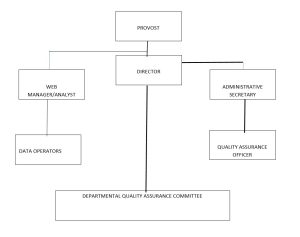
Administrative Structure
Organogram of Quality Assurance Directorate
Quality Assurance Unit Organogram